



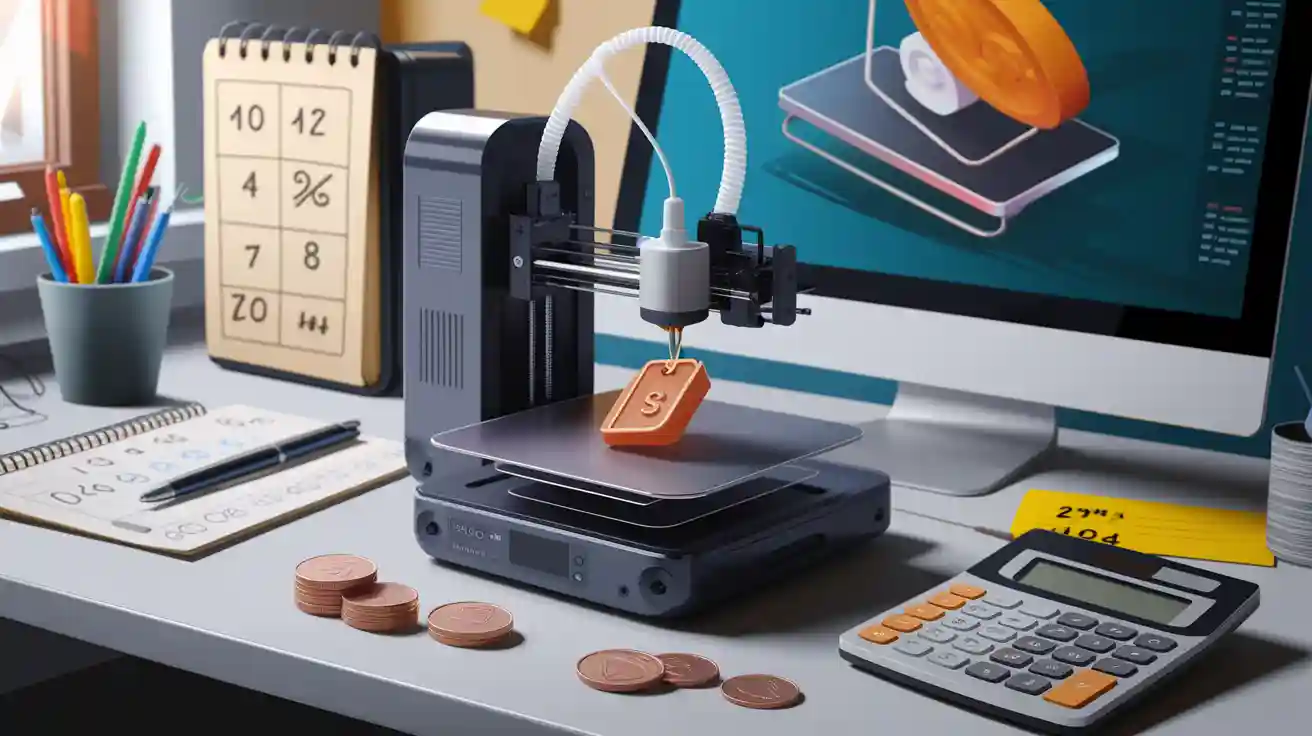
When you ask, "how much does a 3d printer cost," you will find a wide price range based on your needs. Entry-level 3d printers start under $500, while hobbyist models range from $200 to $7,500. Professional options cost between $2,500 and $9,999, and industrial machines can exceed $25,000.
|
Category |
Price Range |
|---|---|
|
Entry-level |
Up to $499 |
|
Hobbyist |
$200 - $7,500 |
|
Professional |
$2,500 - $9,999 |
|
Industrial |
$25,000+ |
You will notice that how much does a 3d printer cost depends on the printer type, features, and your intended use.
Key Takeaways
3D printer prices vary widely based on type and features. Entry-level models start under $500, while industrial machines can exceed $25,000.
Consider your needs before purchasing. Entry-level printers suit beginners, while hobbyist and professional models offer advanced features for more serious users.
- Ongoing costs matter. Budget for materials, maintenance, and accessories to avoid unexpected expenses and ensure cost-effective printing.
- Larger build volumes increase printer costs. Choose a printer that matches your typical project size to maximize value.
- Research customer support and user communities. Reliable resources enhance your printing experience and help solve problems.
3d Printer Cost Overview
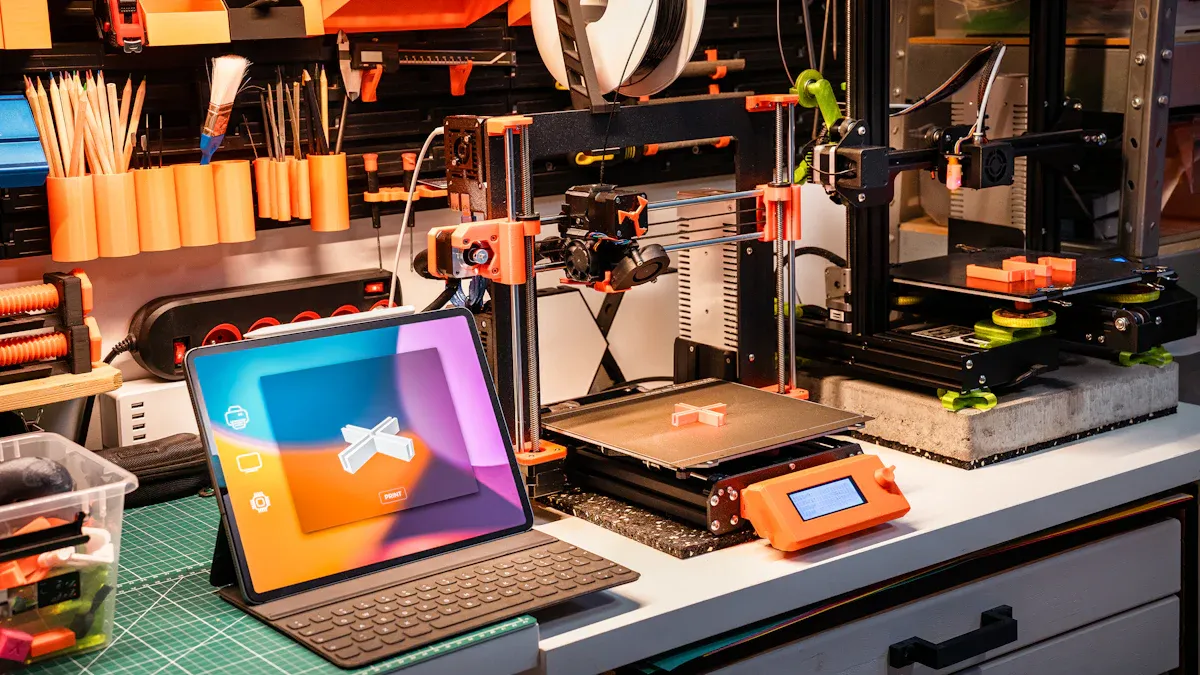
When you explore the world of 3d printers, you will notice a wide range of price points and features. Understanding 3d printer cost helps you choose the right machine for your needs, whether you are a beginner, hobbyist, professional, or enterprise user. Let's break down the current 3d printer pricing landscape and see what you get at each level.
Entry-Level 3d Printer Cost
Entry-level 3d printers for beginners offer an affordable way to start 3d printing. You can expect prices to range from $100 to $400. These machines focus on ease of use, reliability, and basic features. Many models come pre-assembled or require minimal setup, making them ideal for classrooms, home use, or anyone new to 3d printing.
Here is a comparison of popular entry-level models:
|
Model |
Price |
Features |
|---|---|---|
|
Anycubic Kobra 2 |
$249 |
Automatic leveling, direct drive extruder, modular assembly, 300 mm/s |
|
Toybox 3D |
$299-$349 |
Fully assembled, automatic leveling, easy to use |
|
General Entry-Level |
$300-$400 |
Direct drive extruder, higher-quality hotend, auto-leveling, reliable parts |
You will find that 3d printers for beginners often include automatic bed leveling and direct drive extruders. These features simplify the printing process and improve reliability. Entry-level 3d printer cost remains low, but you may see limitations in build volume and advanced capabilities.
Hobbyist 3d Printers Cost
Hobbyist 3d printers appeal to users who want more control, higher print quality, and advanced features. Prices for hobbyist 3d printers typically range from $300 to $1,500, with some models reaching up to $7,500 for specialized machines. You can choose from FDM and resin printers, each offering unique benefits.
Here is a table comparing several popular hobbyist models:
|
Product Name |
Price Range |
Key Features |
|---|---|---|
|
Creality K2 Plus Combo 3D Printer |
$969.56–$1,031 |
Multi-color printing, 600mm/s speed, auto-leveling |
|
Portable 3D Printer (FDM, 100x100x100mm) |
$85.50–$135.43 |
Compact, beginner-friendly, PLA/TPU compatibility |
|
ANYCUBIC Photon Mono M7 Pro (Resin Bundle) |
$457.60–$635.66 |
High-resolution resin printing, wash/cure system included |
|
ELEGOO Neptune 4 Pro (FDM) |
$289.00–$299.00 |
500mm/s speed, CoreXY design, direct drive extruder |
|
UniFormation GK3 Ultra Resin Printer |
$999.00–$1,137.43 |
16K resolution, automatic resin feeder, heated build chamber |

You will see hobbyist 3d printers like the Bambu Lab P1S 3D Printer frequently purchased for their balance of price and performance. Most hobbyist 3d printers cost between $400 and $1,000. These machines suit makers, educators, and small businesses who want to experiment with different materials and achieve higher-quality prints.
Tip: If you want to upgrade from entry-level, hobbyist 3d printers offer larger build volumes, faster speeds, and more advanced features such as multi-color printing and heated build chambers.
Professional 3d Printer Cost
Professional 3d printers deliver precision, reliability, and advanced capabilities for commercial use. You will find professional desktop FDM printers priced from $2,000 to $8,000, while desktop SLA models range from $2,500 to $10,000. Large-format resin printers can reach $25,000. These machines support engineering-grade materials and complex geometries.
Here is a table of frequently used professional models and their price points:
|
Printer Model |
Price |
|---|---|
|
Lulzbot Mini |
$1500 |
|
VIVEDINO T-Rex 3 |
$1600 |
|
MakerGear M3 |
$2550 |
|
Lulzbot Taz Workhorse |
$3000 |
|
Ultimaker S5 |
$2000+ |
|
Formlabs Form 3 |
$2000+ |
|
Stratasys F900 |
$6000+ |
|
EOS Formiga P 110 |
$6000+ |
Professional 3d printers cost more due to their robust construction, high-resolution output, and support for advanced materials. You will see these machines in design studios, research labs, and manufacturing environments. Professional 3d printers offer features such as dual extrusion, enclosed build chambers, and remote monitoring.
Note: Professional 3d printer pricing reflects the need for consistent performance and support. If you run a business or require prototypes with tight tolerances, investing in professional 3d printers ensures reliable results.
Industrial 3d Printer Cost
Industrial and enterprise 3d printers represent the top tier of 3d printing technology. These machines handle large-scale production, complex parts, and demanding materials. Industrial 3d printer cost starts at $10,000 and can exceed $100,000, depending on build volume, technology, and automation features.
Here is a comparison of industrial models and their price ranges:
|
3D Printer Model |
Price Range |
|---|---|
|
EVO 2X Largest Commercial 3D Printer |
$16,995.00 – $18,495.00 |
|
EVO 22 Large Format 3D Printer |
$12,799.00 |
|
EVO Additive Manufacturing Center & Industrial 3D Printer |
$8,499.00 |
|
EVO R 3D Printers for Schools & Engineering Needs |
$5,499.00 |
|
AXIOM 20 Large Build Volume 3D Printer |
$10,995.00 |
|
AXIOM DUAL Extruder 3D Printer with Direct Drive |
$6,499.00 |
|
AXIOMe Desktop 3D Printer for Schools |
$4,399.00 |
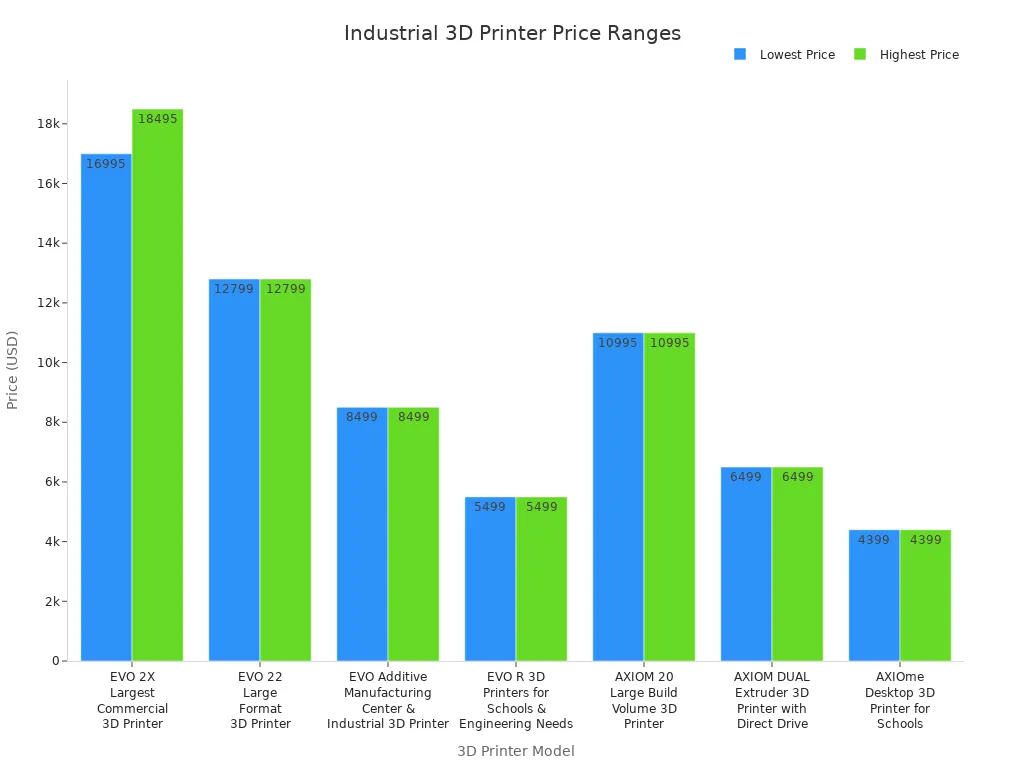
You will find that enterprise 3d printers typically cost between $20,000 and $100,000. Initial investment for enterprise 3d printers often ranges from $50,000 to $100,000, with annual service contracts costing $5,000 to $10,000. These machines serve aerospace, automotive, healthcare, and large-scale manufacturing sectors.
Callout: If your business requires mass production, rapid prototyping, or custom manufacturing, industrial 3d printers provide unmatched speed, accuracy, and material versatility.
Factors Affecting 3d Printers Cost
Understanding what drives 3d printers cost helps you make informed decisions and select the right machine for your needs. Several factors play a role, including printer type, build volume, print quality, and the features and support offered by manufacturers.
Printer Type
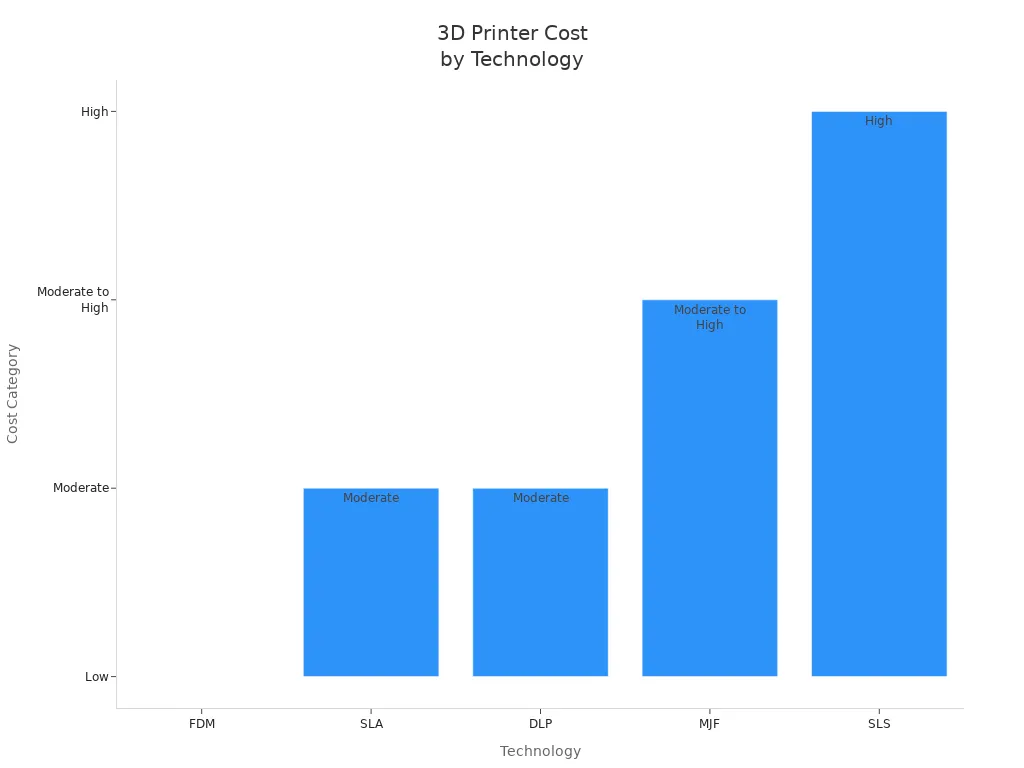
The type of 3d printer you choose has a direct impact on both the initial investment and ongoing expenses. FDM (Fused Deposition Modeling) printers remain popular among hobbyists and students due to their affordability and simple post-processing. You can purchase an FDM printer for as little as $200, while industrial models reach $200,000 or more. SLA (Stereolithography) printers offer higher resolution and smoother finishes, but you pay more for both the printer and the liquid resin materials. SLS (Selective Laser Sintering) printers cost significantly more and serve enterprise users who require functional parts and batch production.
|
Technology |
Initial Printer Price Range |
Material Type |
Post-Processing Cost |
Notes on Operational Costs |
|---|---|---|---|---|
|
FDM |
$200+ (hobbyist) to $200,000+ (industrial) |
Filaments |
$3,000+ |
Most affordable; simple post-processing |
|
SLA |
$2,000 to $200,000+ |
Liquid resin |
$1,000+ |
High resolution; solvent cleaning needed |
|
DLP |
Comparable to SLA, higher for large models |
Liquid resin |
$30,000+ |
Fast, high throughput; limited materials |
|
LCD |
Lower than SLA and DLP |
Liquid resin |
$1,000+ |
Fast curing; frequent consumable replacement |
Material costs also vary by printer type. FDM filaments such as PLA, ABS, or PETG typically cost $20–$50 per kilogram. Resin printers use photopolymer resins that range from $100 to $200 per liter, with specialty resins costing even more. SLS printers use nylon powders priced between $60 and $200 per kilogram, offering high recyclability. These differences in material and operational costs make it essential for you to consider total ownership expenses, not just the upfront price.
Tip: If you plan to print detailed models or functional prototypes, SLA and SLS printers deliver superior results but require a larger budget.

Build Volume
Build volume determines the maximum size of objects you can print. Larger build volumes increase the price of a 3d printer, especially for professional and enterprise models. Hobbyist printers typically offer build volumes of 6 to 8 inches per side, while enthusiast models reach 8 to 12 inches. Professional printers provide 10 to 12 inches or more, and enterprise machines support even larger volumes for high-temperature materials.
|
Category |
Price Range |
Typical Build Volume |
|---|---|---|
|
Hobbyist 3D Printers |
$200 - $1500 |
6" to 8" on a side |
|
Enthusiast 3D Printers |
$1,000 - $4,000 |
8" to 12" in each dimension |
|
Professional 3D Printers |
$4,000 - $20,000 |
10" – 12"+ in each dimension |
|
Enterprise 3D Printers |
$20,000 – $100,000 |
High quality, large volumes for high temperature materials |
If you need to print large prototypes or production parts, you should expect to pay more for a printer with a bigger build volume. Small desktop printers suit personal projects, while enterprise printers handle industrial-scale production.
Print Quality
Print quality depends on several technical metrics, including resolution, nozzle size, frame stability, and material compatibility. Higher-priced printers deliver finer resolution, smoother surfaces, and better support for complex geometries. SLA and DLP printers excel in precision, making them ideal for jewelry, dental, and intricate design applications. FDM printers offer moderate accuracy, suitable for prototyping and hobby projects.
|
Metric |
Description |
|---|---|
|
Resolution |
The smallest movements the printer can make, affecting detail and smoothness of prints. |
|
Nozzle Size |
Smaller nozzles allow for more intricate details and better support for complex geometries. |
|
Stability of Frame |
A sturdy frame reduces vibrations, leading to improved print quality. |
|
Material |
Different materials can yield varying levels of accuracy and ease of printing. |
|
Technology |
SLA printers generally offer better precision compared to FDM printers. |
|
Slicer Settings |
Proper optimization of slicer settings is crucial for achieving high-quality prints. |
Note: If your application demands high accuracy and smooth finishes, investing in a professional or enterprise printer ensures consistent results.
Features and Support
Advanced features and strong customer support add to 3d printers cost. Features such as auto-leveling, heated build chambers, multi-material printing, and remote monitoring increase the price but improve usability and reliability. The choice of infill type also affects cost, with solid infill providing maximum strength at a higher price.
|
Infill Type |
Description |
Cost Impact |
|---|---|---|
|
Ultralight |
Single zig-zag pattern, least expensive |
Low |
|
Light |
Double cross-hatch pattern, increased rigidity |
Moderate |
|
Solid |
Completely filled, highest density |
High |
Manufacturers with a reputation for quality and reliability charge more for their products. You pay a premium for brands that invest in research and development and offer excellent customer support. This assurance in service and product reliability is especially valuable for enterprise users who depend on consistent performance.
Powder bed fusion processes, such as SLS and DMLS, increase costs due to their complexity.
Extruding and jetting processes may also raise expenses based on material ejection methods.
Callout: If you value long-term reliability and responsive support, choosing a reputable brand with strong customer service justifies the higher cost.
What You Get for the Cost
Features by Price Range
You gain access to different features as you move up the price ladder for 3d printers. Entry-level models focus on basic functionality and ease of use. Hobbyist printers offer better print quality and moderate speed. Professional desktop machines provide advanced capabilities, larger build volumes, and support for multiple materials. Industrial printers deliver the highest accuracy, speed, and reliability for enterprise production.
|
Price Range |
Type of 3D Printer |
Features |
|---|---|---|
|
$100 - $500 |
3D Printers For Beginners |
Basic functionality, easy-to-use interface, lacks high accuracy and quick print times. |
|
$500 - $1,500 |
Hobbyist 3D Printers |
High-quality prints, decent speeds, limited material compatibility. |
|
$1,000 - $10,000 |
Professional Desktop 3D Printers |
High-end capabilities, larger build volumes, dual extrusion, compatible with various materials. |
|
$10,000 - $100,000+ |
Large Industrial 3D Printers |
Advanced features, excels at accuracy, speed, and reliability for large-scale production. |
Tip: If you want precise results or need to print with specialty materials, consider investing in a professional or industrial model. These machines justify their higher cost with advanced technology and robust construction.
Use Cases by Cost
You should match your 3d printer choice to your intended application. Entry-level printers suit domestic problem-solving and educational projects. Hobbyist models excel at creating custom figurines, cosplay props, and gaming accessories. Professional printers support rapid prototyping and product demos for business communication. Industrial machines enable enterprise solutions, such as custom implants in healthcare, lightweight automotive parts, and innovative fashion designs.
|
Printer Type |
Common Use Cases |
|---|---|
|
Entry-Level |
Domestic problem-solving, DIY projects, educational and recreational items like chess sets. |
|
Hobbyist |
Custom figurines, cosplay props, gaming gear, and unique musical instruments. |
|
Professional |
Rapid prototyping, product demos, and mockups for effective communication in business settings. |
|
Industrial |
Custom implants in healthcare, lightweight parts in automotive and aerospace, innovative fashion designs. |
Domestic use includes printing missing parts and custom containers.
Entertainment applications involve designing props and collectibles.
Industrial uses focus on rapid prototyping and custom manufacturing for enterprise needs.
Note: Higher resolution and advanced materials increase 3d printers cost. You pay more for complex technology and labor, but you gain superior performance and reliability.
Additional 3d Printer Costs
When you budget for a 3d printer, you must consider more than the initial purchase price. Ongoing expenses can impact your total investment and affect your ability to achieve cost-effective printing over time. You should review the main categories of additional costs: materials and filaments, maintenance, and accessories.
Materials and Filaments
Material costs represent a significant part of your long-term expenses. The type of material you choose depends on your printer and your intended application. For FDM printers, you often use PLA, ABS, or PETG filaments. Specialty composites cost more but offer advanced properties for enterprise projects.
|
Material Type |
Price Range (per kg) |
Application Example |
|---|---|---|
|
PLA |
$20 - $30 |
Decorative items, prototypes |
|
ABS |
$25 - $40 |
Functional parts, mechanical components |
|
PETG |
$22 - $35 |
Durable, flexible prints |
|
Specialty Composites |
$100 - $200 |
Engineering-grade, enterprise solutions |
|
Resin |
$20 - $200 per liter |
Detailed prints, dental, jewelry |
|
SLS Powder |
$100 - $250 per kg |
High-performance engineering parts |
You also need to account for electricity usage. Most printers consume 50 to 500 watts per hour. If you print for 10 hours, your electricity cost ranges from $0.065 to $0.65. These numbers help you estimate your ongoing expenses and plan for cost-effective printing.
Maintenance
Routine maintenance ensures your printer operates smoothly and delivers consistent results. You must clean your printer regularly, troubleshoot issues, and inspect final products. Maintenance tasks include loading materials, preparing digital files, and finishing printed parts. These activities require time and may lead to additional costs for replacement parts or upgrades.
- Regular cleaning
- Troubleshooting
- Ensuring optimal working condition
- Preparing and loading digital files
- Loading material into the printer
- Cleaning and finishing printed parts
- Inspecting final products
- General maintenance tasks
You should factor these tasks into your budget to maintain cost-effective printing and avoid unexpected expenses.
Accessories
Accessories and service contracts can increase your total cost. You may need proprietary consumables, post-processing equipment, or extended warranties. For enterprise users, service contracts often represent 15-20% of the overall cost. For example, a $100,000 printer may require a $15,000 to $20,000 annual service contract.
|
Cost Type |
Estimated Percentage of Overall Cost |
Example Cost for $100,000 Printer |
|---|---|---|
|
Service Contract |
15-20% |
$15,000 - $20,000 |
|
Proprietary Consumables |
Varies |
N/A |
|
Post-Processing Equipment |
Varies |
N/A |
Tip: You should always include materials, maintenance, and accessories in your budget. These ongoing expenses help you achieve cost-effective printing and maximize the value of your 3d printer investment.
How to Choose Based on 3d Printer Cost
Match Needs to Cost
You should start by identifying your primary goals for 3d printing. Consider how you plan to use the machine, whether for concept models, functional prototypes, or production parts. Each application demands different levels of accuracy, build size, and material properties. For example, if you need high-resolution surface finishes for jewelry or dental models, select a printer with advanced technology and higher cost. If you want to print large mechanical parts, focus on build volume and material compatibility.
The following table helps you compare key criteria when matching your needs to the right 3d printer:
|
Criteria |
Description |
|---|---|
|
Application |
Intended use: models, prototypes, production parts |
|
Accuracy; Resolution; Surface Finish |
Required detail and finish level |
|
Build Size |
Maximum part size for 95% of your projects |
|
Material |
Stiffness, flexibility, chemical resistance |
|
Monochrome or Color |
Need for color capability |
|
Build Speed |
Printing speed based on part size and geometry |
|
Maintenance |
Ease of use and upkeep |
|
Post-processing Requirements |
Finishing steps needed after printing |
|
Initial Investment |
Upfront purchase cost |
|
Recurring Cost of Ownership |
Ongoing expenses for materials and maintenance |
Tip: You should choose a printer that meets your most frequent needs, not just the largest or most expensive option.
Tips for Buyers
When you select a 3d printer, you can follow these practical steps to make a confident decision:
Define your main goals. Decide if you need the printer for prototyping, repairs, or production. This helps you choose the right technology and features.
Plan your budget. Include the printer price, materials, maintenance, and upgrades. This prevents unexpected costs.
Check customer support and user communities. Reliable resources help you solve problems and improve your printing experience.
Follow a maintenance schedule. Clean and lubricate your printer, calibrate components, and inspect parts for safety.
Note: You should always compare models based on your specific needs and total cost of ownership. A well-matched printer delivers better results and saves money over time.
- You need to understand the main price ranges and what drives the cost of a 3d printer before making a decision.
- Entry-level models suit basic projects and learning.
- Hobbyist printers offer better quality and more features.
- Professional and industrial machines deliver advanced capabilities for business and manufacturing.
Always compare your needs to available features. Consider both the initial investment and ongoing expenses to maximize value.
FAQ
Why do 3D printers have such a wide price range?
You see a wide price range because printer type, build volume, print quality, and advanced features all affect cost. Industrial models use specialized materials and offer higher precision, which increases the price.
Why should you consider ongoing costs when buying a 3D printer?
You need to budget for materials, maintenance, and accessories. Filaments, resins, and service contracts add to your total investment. Ignoring these costs can lead to unexpected expenses and reduced printing efficiency.
Tip: Always calculate total ownership cost before making a purchase.
Why do professional and industrial 3D printers cost more?
Professional and industrial printers use advanced technology, support larger build volumes, and deliver higher accuracy. You pay more for robust construction, specialized materials, and reliable customer support.
Why is build volume important when choosing a 3D printer?
Build volume determines the maximum size of objects you can print. Larger build volumes suit prototypes and production parts. You should select a printer that matches your typical project size to avoid unnecessary spending.
Why do some 3D printers require specific materials?
Certain printers use proprietary filaments or resins to achieve optimal performance. You must use compatible materials to ensure print quality and avoid damaging your machine.
Note: Always check material compatibility before purchasing a 3D printer.
Authoritative sources and data annotations:
- 3D Printing Industry
- All3DP
- Formlabs White Papers
- Statista: 3D Printing Market Data