

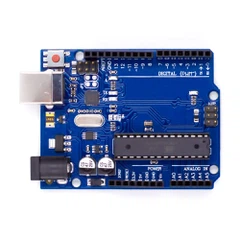
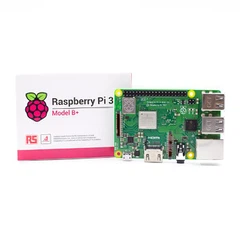


You now see AI and IoT hardware reshaping industries at record speed. The global AI in IoT market has soared to $78.7 billion in 2024, with edge computing leading 54.3% of deployments. Major tech companies like Microsoft and Amazon have invested billions in next-generation infrastructure.
Recent innovations-such as on-device AI accelerators-let you use a development board for real-time analytics and intelligent decision-making at the edge.
Specialized Development Board Overview
Unique Features
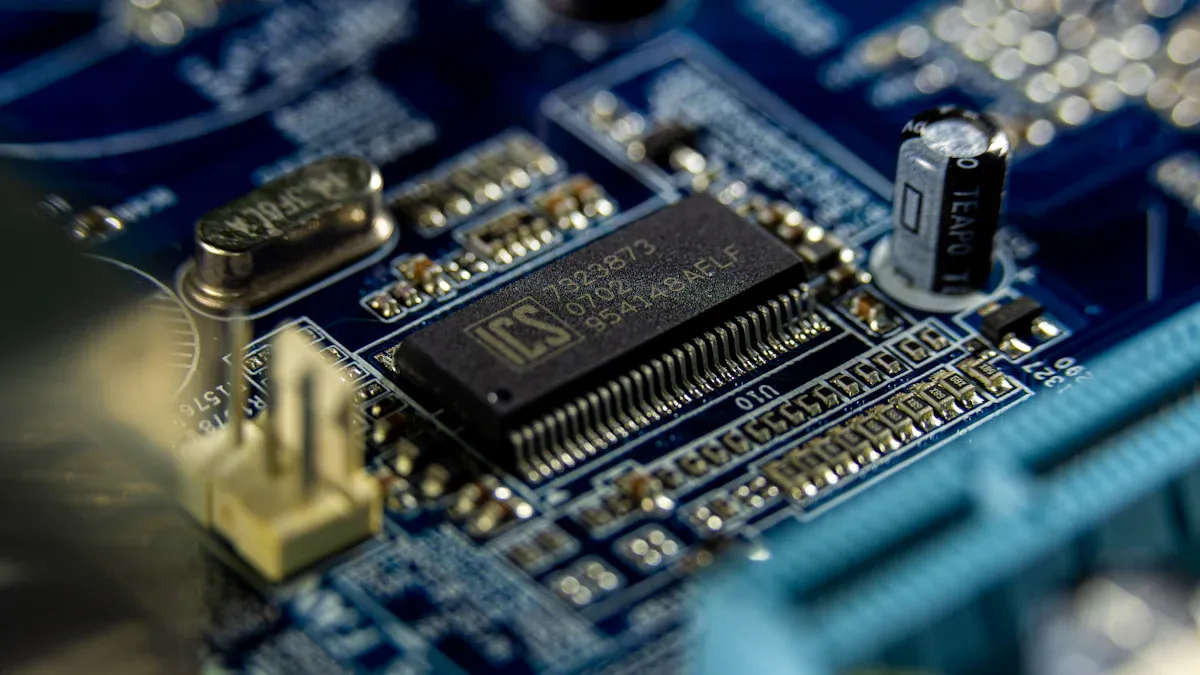
When you explore specialized development boards for AI and IoT, you discover a range of features that set them apart from older, general-purpose boards. These boards combine powerful processors, advanced connectivity, and integrated sensors to meet the demands of modern applications. The table below highlights some of the most popular boards and their unique capabilities:
|
Development Board |
Processor & AI Features |
Connectivity Options |
Sensors & Peripherals |
Memory & Storage |
Special Features & Use Cases |
|---|---|---|---|---|---|
|
Arduino Nano 33 BLE Sense |
nRF52840, TensorFlow Lite AI |
Bluetooth 5.0 |
Temp, humidity, motion, gesture |
Low power |
Environmental monitoring, wearables |
| Development board A |
Dual-core Xtensa, 240 MHz |
Wi-Fi, Bluetooth |
Touch pins, ADC channels |
520KB RAM, 4MB flash |
Smart home, data logging |
| Development board B |
Dual ARM Cortex-A15, DSP, GPU |
Ethernet, Wi-Fi, Bluetooth |
USB 3.0, HDMI |
1GB RAM, 16GB eMMC |
Edge AI, AI frameworks |
| Development board C |
6-core ARM CPU, 384-core GPU |
Multiple I/O, camera support |
High-performance AI processing |
8GB LPDDR4x |
Computer vision, robotics |
| Development board D |
ESP32-D0WDQ6 |
Wi-Fi, Bluetooth |
LCD, touch panel, 6-axis IMU |
microSD slot |
Modular, rapid prototyping |
| Development board E |
Intel Celeron N5105 |
Wi-Fi 6, Bluetooth 5.2, Ethernet |
N/A |
Up to 8GB RAM, 64GB eMMC |
Advanced IoT, edge computing |
| Development board F |
Nordic nRF52840, LTE module |
Wi-Fi, Bluetooth, LTE |
20 GPIOs, analog channels |
256KB RAM, 4MB flash |
Cellular IoT, cloud integration |
| Development board G |
Dual processor, ULP coprocessor |
Wi-Fi, Bluetooth, LoRa, Sigfox, LTE-M |
GPIO, ADC monitoring in deep sleep |
4MB RAM, 8MB Flash |
Multi-network IoT, ultra-low power |
| Development board H |
STM32 microcontrollers |
Multiple I/O |
Arduino-compatible headers |
N/A |
High performance, RTOS support |
| Development board I |
ARM Cortex-M33, LTE-M/NB-IoT modem |
Bluetooth LE, LTE-M, NB-IoT |
Temp, humidity, air quality, color, light |
Battery powered |
Cellular IoT prototyping, asset tracking |
| Development board J |
Kendryte K210, Neural Network Processor |
N/A |
Touchscreen, camera, microphone, speaker |
8MB SRAM |
Edge AI, computer vision, audio processing |
You can see that these boards offer much more than basic computing. They include AI accelerators, support for machine learning frameworks, and a wide range of wireless options. Many boards also feature onboard sensors for environmental and
motion detection, making them ideal for real-time analytics and smart device applications.
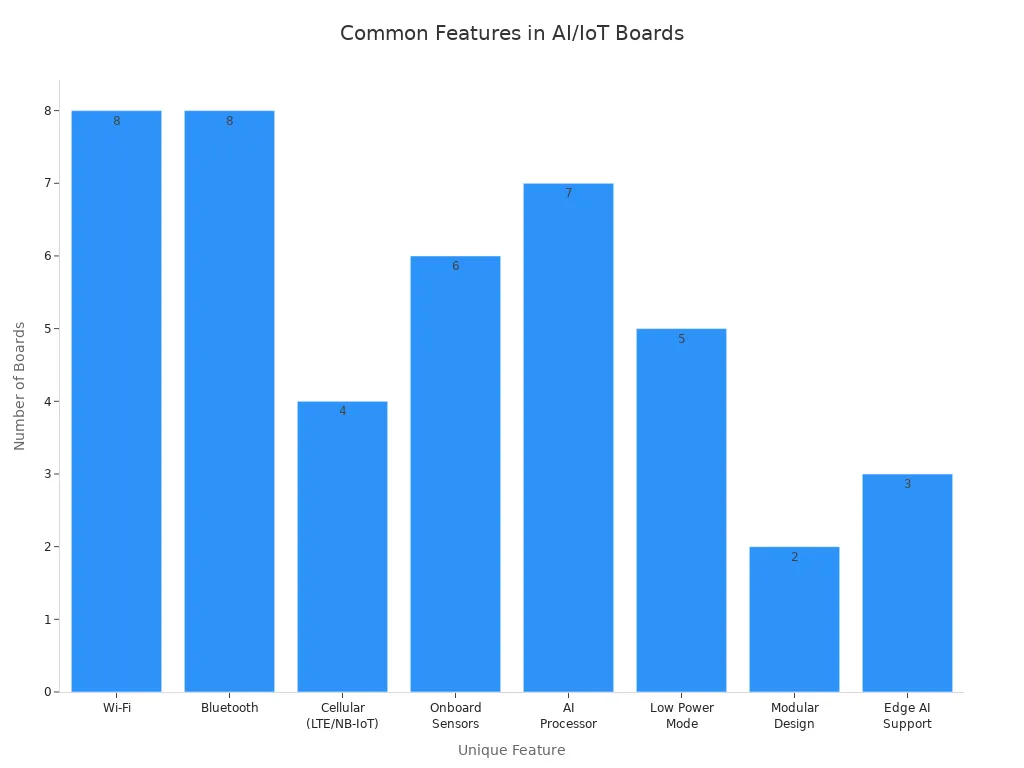
Tip: If you want to build a device that reacts instantly to its environment, look for a development board with onboard AI processing and multiple sensor options. This combination allows you to run machine learning models directly on the device, reducing the need for cloud communication and improving response times.
Recent hardware innovations have made these features possible. Boards now use specialized microcontrollers and AI accelerators, such as GPUs and neural processors, to handle complex tasks like image recognition and voice processing. Improvements in motherboard design, energy efficiency, and modularity also help you create smarter, more reliable devices for any industry.
Comparison to Traditional Boards
When you compare specialized development boards to traditional ones, the differences become clear. Traditional boards like the Arduino Uno Rev3 have an 8-bit processor, 16 MHz clock speed, and limited memory. These boards work well for simple projects but struggle with the demands of AI and IoT.
Specialized boards, on the other hand, deliver much higher performance and flexibility. They use 32-bit or 64-bit processors, offer advanced connectivity (Wi-Fi 6, Bluetooth 5.2, LTE), and support real-time processing. Many include AI accelerators, which allow you to run deep learning models at the edge. This is essential for applications like autonomous vehicles, smart cameras, and industrial automation.
The table below summarizes the main differences:
|
Feature/Metric |
Traditional Boards (e.g., Arduino Uno) |
Specialized Development Boards (e.g., Jetson Orin, ESP32) |
|---|---|---|
|
Processor |
8-bit, low speed |
32/64-bit, high speed, AI accelerators |
|
Memory & Storage |
2 KB SRAM, 32 KB Flash |
Up to 8GB RAM, 64GB eMMC, advanced storage |
|
Connectivity |
Basic (USB, limited I/O) |
Wi-Fi, Bluetooth, Ethernet, LTE, LoRa, Sigfox |
|
Sensors & Peripherals |
Few, external modules |
Onboard sensors, touch, IMU, camera, microphone |
|
AI/ML Support |
None |
Built-in, supports TensorFlow Lite, CUDA, etc. |
|
Power Efficiency |
Moderate |
Ultra-low power, sleep modes, battery support |
|
Use Case |
Simple automation, learning |
Edge AI, robotics, smart cities, healthcare, wearables |
|
Expandability |
Limited |
Modular, highly expandable |
|
Setup & Integration |
Manual, more coding |
Plug-and-play, rapid prototyping |
Specialized boards also address the technical demands of AI and IoT by optimizing for speed, power efficiency, and real-time processing. For example, the NVIDIA Jetson Orin Nano uses a quad-core ARM CPU and 1024 CUDA cores to deliver high-speed AI inference for robotics and computer vision. The ESP32-S3 combines wireless connectivity with AI acceleration, making it perfect for smart sensors and IoT gateways.
You benefit from these advancements because they let you build devices that process data locally, respond instantly, and operate efficiently in the field. This is a major leap forward compared to traditional boards, which often require cloud connections and cannot handle complex AI workloads.
AI and IoT Impact
Processing Demands
AI and IoT have changed the way you process data. These technologies require much more than basic computing power. You now face workloads that demand rapid execution of complex algorithms, real-time responsiveness, and the ability to handle large datasets. Specialized hardware has become essential for meeting these needs.
Data Processing Units (DPUs) offload data-centric tasks from CPUs. This improves server throughput and efficiency.DPUs handle security, packet processing, and data transfer. You see optimized performance for AI and IoT applications.
These units act as advanced storage controllers. They accelerate data compression and encryption, which reduces CPU I/O overhead.DPUs manage network traffic and storage I/O with precision. This supports real-time processing demands.Highly parallel architectures in DPUs increase data processing speeds. You experience lower latency in data-intensive environments.Energy-efficient designs lower overall power consumption. This makes data centers more sustainable.
DPUs support workload isolation and high availability. They also enable data reduction techniques for better workload management.
AI workloads, especially those involving large models like Generative AI, require vast processing power, high-speed connectivity, and significant storage. You need specialized hardware such as GPUs and TPUs for training and inference. These components often demand advanced cooling solutions, including liquid cooling, to handle the heat generated by intense computations. Hyperscale data centers continue to expand their infrastructure to meet these demands, addressing challenges like power supply and fiber connectivity.
You also see that AI and IoT workloads require:
1.Rapid and efficient execution of AI algorithms
2.Handling of large datasets and complex models
3.High-speed data transfer and low latency
4.Real-time responsiveness
Specialized development boards address these challenges by integrating CPUs, GPUs, NPUs, FPGAs, and DPUs. These components offload data-centric tasks, accelerate AI computations, and optimize energy consumption. High memory bandwidth and parallel processing capabilities support the training and inference of large AI models. Edge computing for IoT relies on these boards to provide near-real-time data analysis and responsiveness. Client devices with integrated NPUs allow you to run AI workloads efficiently on-device, improving speed and reducing reliance on cloud connectivity.
Note: The computational intensity and energy consumption of AI workloads drive the need for specialized development boards and hardware accelerators. You benefit from faster processing, lower latency, and more efficient energy use.
Edge Intelligence
Edge intelligence lets you process data closer to where it is generated. This approach reduces the need to send all information to the cloud. You gain faster response times and lower data transmission costs. Specialized development boards play a key role
in enabling edge intelligence in AIoT systems.
|
AIoT Application Phase |
Processing Requirements |
Hardware/Tools Used |
Edge Intelligence Enablement |
|---|---|---|---|
|
Data Collection |
Moderate CPU and I/O focus; preprocessing to clean data |
Arm Cortex or Intel Atom/Core processors |
Enables local data acquisition and preprocessing at the edge, reducing data transmission needs |
|
Training |
High computational power for ML/DL model training |
Powerful GPUs, cloud or local servers |
Typically done off-edge, but critical for creating models deployed on edge boards |
|
Inferencing |
Efficient, low-latency prediction using trained models |
CPUs or lightweight accelerators; toolkits like Intel OpenVINO, NVIDIA CUDA |
Specialized boards perform real-time AI inferencing locally, reducing latency and bandwidth |
You can choose the right level of edge computing for your application:
Low Level: Minimal processing, quick decisions, low power. Arm-based platforms without accelerators work well for simple IIoT devices and reduce cloud dependency.
Medium Level: Handles moderate complexity, such as video analytics. High-performance CPUs and entry-level GPUs balance performance and power. Fanless designs are preferred for industrial use.
High Level: Supports complex pattern recognition and heavy data loads. High-end GPUs, VPUs, TPUs, and FPGAs require more power and cooling. These are often deployed near the edge rather than far from it.
Specialized development boards enable edge intelligence by addressing challenges such as integrating AI into legacy infrastructure and managing diverse hardware and connectivity environments. These boards provide options like CPUs with built-in accelerators for moderate workloads, GPUs for demanding tasks, and FPGAs for flexible, high-performance AI processing. You benefit from small form factors, low power consumption, and enhanced security features. These features allow you to deploy AI inferencing directly at the edge, enabling real-time decision-making and reducing latency.
Tip: When you use a development board with edge intelligence, you can operate in harsh industrial environments. Features like ruggedness, wide temperature range, fanless design, and vibration resistance ensure reliability. Integrated cellular LTE and dual SIM support help maintain communication in remote or space-limited deployments.
Edge intelligence transforms how you manage data in AIoT systems. You gain the ability to make decisions instantly, improve efficiency, and reduce operational costs. This shift empowers you to build smarter, more autonomous solutions across industries.
Key Benefits
Real-Time Analytics
You can unlock powerful real-time analytics with specialized boards. These platforms process data instantly at the edge, which means you get immediate insights without waiting for cloud servers. The table below shows how different board types support real-time analytics in AI and IoT:
|
Board Type |
Key Benefits |
Supporting Details |
|---|---|---|
|
Microcontrollers (MCUs) |
Power efficiency, cost-effectiveness |
Great for battery-powered devices and simple AI tasks. |
|
Microprocessors (MPUs) |
Complex AI model support, multitasking |
Run advanced workloads like computer vision and natural language processing. |
|
Single-board Computers (SBCs) |
Rapid development, reliability, scalability |
Ready-to-use platforms help you launch products faster and scale as needed. |
|
Particle Tachyon |
On-device AI, built-in 5G, broad ecosystem |
Analyze sensor data and run computer vision tasks efficiently at the edge. |
|
NVIDIA Jetson AGX Orin |
High AI processing power, extensive AI software |
Handle deep learning and demanding real-time workloads in robotics and industrial automation. |
You gain the ability to process sensor data, detect anomalies, and trigger alerts in milliseconds. This speed helps you respond to critical events and optimize operations.
Connectivity
You need strong connectivity to link devices, sensors, and cloud services. Specialized boards offer advanced options that keep your systems running smoothly:
- Support for Wi-Fi, Bluetooth, LTE, and even 5G for fast, reliable communication.
- Easy integration with many devices using protocols like MQTT, CoAP, and HTTP.
- Ability to manage up to 1,000 devices per instance, making large-scale deployment possible.
- Persistent local storage ensures no data loss during outages.
- Real-time dashboards and batch updates help you monitor and control your network efficiently.
- Tip: With low-latency edge computing and AI, you can make near-instant decisions and keep your operations connected, even in remote locations.
Security
Security remains a top priority in AI and IoT systems. Specialized boards help you protect sensitive data and maintain system integrity:
- Integrated security features guard against unauthorized access and cyber threats.
- Local data processing reduces the risk of data interception during transmission.
- Customizable rule engines let you set alarms and automate responses to suspicious activity.
- Offline operation ensures your system continues to function safely, even if the network goes down.
- Flexible processor options and built-in encryption support compliance with industry standards.
- You can trust these boards to keep your data safe while delivering high performance and reliability.
Industry Use Cases
Healthcare
You see hospitals and clinics using AI-powered development boards to improve patient care. These boards process medical images, monitor vital signs, and detect anomalies in real time. For example, Jetson Nano and BeagleBone AI-64 support machine learning models that analyze X-rays and MRI scans. You can deploy these boards in portable diagnostic devices, allowing doctors to make faster decisions. Remote patient monitoring becomes more reliable because the boards collect and analyze data from wearable sensors. You help reduce response times and improve outcomes for patients with chronic conditions.
Tip: You can use a development board with onboard AI to create smart devices that alert medical staff to emergencies, such as sudden drops in heart rate or oxygen levels.
Manufacturing
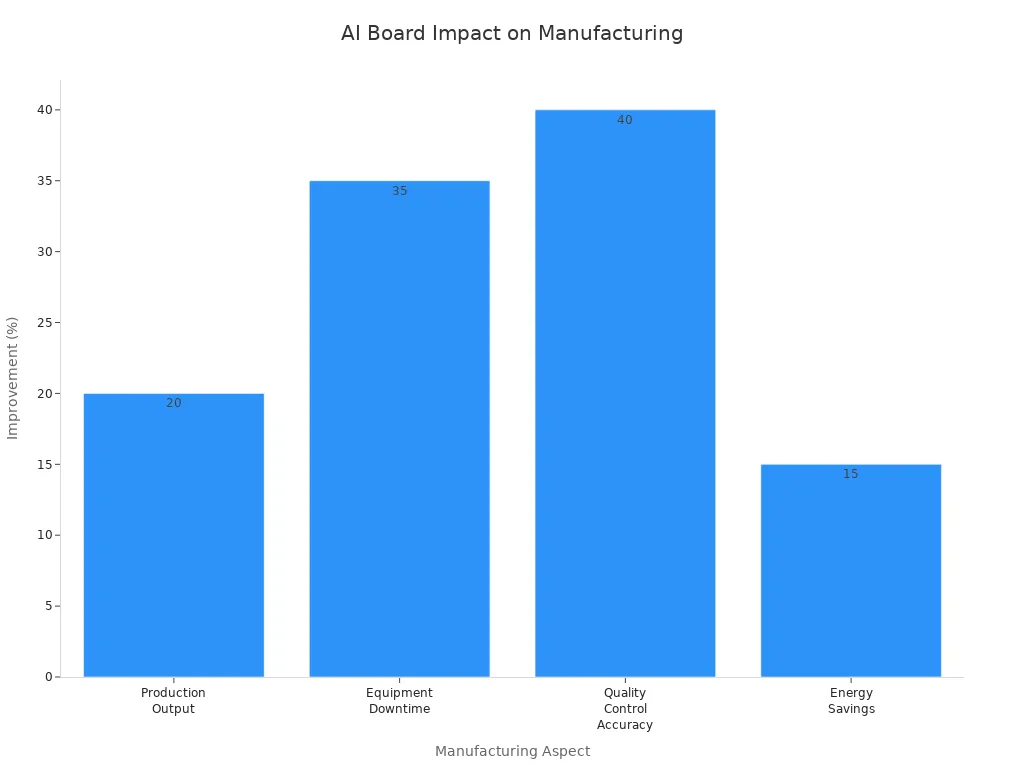
You transform manufacturing by integrating AI and IoT with specialized development boards. These boards retrofit existing machinery with sensors, collect real-time data, and run AI algorithms to optimize workflows. You see significant improvements in production output, equipment downtime, quality control, and energy savings.
|
Aspect |
Improvement with AI Integration via Specialized Boards |
|---|---|
|
Production Output |
Up to 20% increase due to optimized workflows |
|
Equipment Downtime |
Reduced by up to 35% through predictive maintenance |
|
Quality Control Accuracy |
Improved by up to 40% via AI-powered defect detection |
|
Energy Savings |
Up to 15% reduction through real-time resource control |
You follow these key steps:
1.Retrofit machines with sensors and IoT devices.
2.Collect and analyze data from production lines.
3.Train and deploy AI models on embedded platforms.
4.Enable autonomous decision-making for self-optimizing systems.
5.Continuously monitor and adjust processes to boost efficiency.
6.You create factories that predict equipment failures, reduce waste, and deliver higher-quality products.
Smart Cities
You help build smart cities by deploying development boards in infrastructure and public services. Boards like Jetson Orin and ToyBrick RK3399 Pro power traffic management systems, environmental monitoring, and public safety networks. You use AI to analyze traffic patterns, optimize signal timings, and reduce congestion. Boards process data from air quality sensors and surveillance cameras, enabling real-time alerts for pollution or security threats. You support autonomous street lighting and waste management, making cities safer and more sustainable.
Note: You can scale these solutions across neighborhoods, using wireless connectivity and edge AI to keep systems running even during network outages.
Adoption Challenges
Integration
You may find that integrating specialized development boards into existing AI and IoT systems presents several obstacles. Security concerns often top the list. Interconnected physical and digital systems can create new cybersecurity risks, especially when devices have open security settings or limited vendor support. Trust issues also arise because many organizations lack confidence in the reliability and flexibility of AIoT systems, especially when handling unusual events.
You might encounter connectivity challenges due to heterogeneous networks and complex device interconnections, which can disrupt data transfer. Environmental risks, such as harsh operating conditions or inadequate infrastructure, further complicate integration.
Other common hurdles include:
Interoperability issues from non-standardized IoT protocols and limited cooperation between vendors.
Difficulty in integrating business processes across diverse enterprise systems.
Increased IT support complexity, as troubleshooting must cover multiple device layers.
Financial barriers, since you need to invest in hardware, software, security, and training, often with uncertain returns.
Tip: To improve integration, you should prioritize security best practices, choose boards with strong vendor support, and use standardized protocols whenever possible.
Scalability
When you scale up AIoT deployments, you face new technical challenges. Device and protocol fragmentation makes large-scale testing difficult. Lack of integration testing and compatibility issues can increase the risk of failures after deployment. Performance testing becomes more complex and requires specialized tools and infrastructure.
You may also struggle with provisioning eSIMs, managing multiple product variations, and ensuring timely certification. These factors add operational complexity and can slow down adoption.
|
Aspect |
Details |
|---|---|
|
Maximum devices managed |
Up to 1,000,000 devices in advanced frameworks |
|
Throughput |
Over 1,000 data packets per second at scale |
|
Latency |
Maintains low latency (~3.2 ms) at maximum scale |
|
Scalability limitations |
Beyond 1 million devices, performance drops and complexity rises |
|
Solutions |
Load balancing, network fragmentation, optimized data management |
Scalability constraints can lead to performance bottlenecks and higher system complexity. You need robust frameworks and automation to ensure efficient provisioning and data handling.
Developer Skills
You need a broad skill set to unlock the full value of specialized development boards in AI and IoT projects. Proficiency in programming languages like C/C++, Python, Java, and JavaScript is essential. You should understand hardware components, including sensors, actuators, and microcontrollers.
Familiarity with networking protocols such as Bluetooth, MQTT, HTTP, CoAP, Zigbee, and LoRaWAN helps you connect devices efficiently. Experience with IoT frameworks and platforms-like Arduino IoT, Node-RED, TensorFlow, AWS IoT, and Google Cloud IoT-enables you to build robust solutions.
You also benefit from skills in API automation, mobile app development, and information security tailored to IoT. Knowledge of AI and machine learning integration, cloud computing, big data handling, and predictive analytics is increasingly important.
Continuous learning and active participation in the IoT community help you stay updated and solve new challenges as the industry evolves.
Future Trends
AIoT Evolution
You see AIoT evolving rapidly as new technologies reshape the way devices interact and make decisions. Hardware improvements now include asymmetric multicore RISC-V architectures and subthreshold power-optimized microcontrollers. These advances boost computing power while keeping energy use low. You also notice new memory technologies, like MRAM, that help devices store and access data faster.
Software trends play a big role. Lightweight firmware such as Zephyr and OpenThread makes it easier to run smart applications on small devices. TinyML frameworks let you use deep learning on resource-limited hardware. Wireless communication is also changing. Protocols like Wi-Fi Halow and standards such as Matter help devices from different brands work together.
Here are some key trends shaping AIoT:
- Open-source RISC-V chips are replacing traditional ARM chips for more customization and lower costs.
- Boards now support multicore processing and low-power operation for real-time, distributed decision-making.
- TinyML frameworks, including TensorFlow Lite and Edge Impulse, enable advanced AI tasks like image recognition and predictive maintenance at the edge.
- New manufacturing methods, such as subthreshold CMOS, allow for smaller, more efficient boards.
- You see a growing need for local AI processing to reduce latency and save bandwidth.
|
TinyML Framework |
Enabled Applications |
|---|---|
|
TensorFlow Lite |
Image/audio classification, object detection, pose estimation, speech/gesture recognition, and more. |
|
Edge Impulse |
Asset tracking, monitoring, predictive maintenance, human interfaces. |
|
uTensor |
Image classification, gesture recognition, acoustic detection, motion analysis. |
|
PyTorch Mobile |
Computer vision, natural language processing. |
|
Nanoedge AI Studio |
Anomaly detection, condition monitoring, people counting, activity recognition. |
Note: Modern boards help you comply with new regulations on data security and environmental sustainability. They use energy-efficient designs and open-source hardware to reduce waste and support green initiatives.
Hardware Customization
You benefit from hardware customization as it shapes the future of AI and IoT. Companies now design chips for specific tasks, moving away from general-purpose CPUs and GPUs. For example, Google's TPUs and Amazon's Trainium2 chips handle AI workloads with better speed and lower power use. Tesla's custom AI chips process data in real time, making autonomous vehicles safer.
FPGAs give you the flexibility to optimize AI algorithms for your needs. You can use them for high-speed video analytics, low-power edge AI in drones, or fast financial predictions. Custom PCIe cards in AI supercomputers show how tailored hardware meets demands for high bandwidth and low latency.
You also see edge AI hardware from Qualcomm and Apple making IoT devices smarter and more efficient. These chips allow devices to respond quickly and use less energy. However, hardware customization brings challenges. You need unified software tools to manage different architectures and ensure your applications run smoothly.
Tip: Hardware customization lets you build solutions that fit your exact needs, but you should plan for software compatibility and future updates.
You see AI and IoT fueling the rise of specialized development boards that transform industries and empower developers. These boards deliver real-time analytics, robust connectivity, and advanced security.
Experts predict edge AI, 5G, and AI accelerators will shape future boards, making devices smarter and more autonomous.
Institutions like Singapore's EDB and JTC show how strategic infrastructure and skill development drive innovation and adaptability.
You can expect ongoing breakthroughs in hardware and software. Consider how these trends may inspire your next project or business strategy. 🚀
FAQ
What makes AI-enabled development boards valuable for industry applications?
You gain real-time analytics, robust security, and scalable connectivity with AI-enabled boards. For example, factories using Jetson Orin boards report up to 35% less downtime and 40% better quality control. Hospitals use BeagleBone AI-64 for instant patient monitoring. These boards process data locally, which reduces latency and improves decision-making.
Tip: Choose boards with onboard AI accelerators for faster results and lower cloud costs.
How do specialized development boards improve efficiency in manufacturing?
- You see major improvements in manufacturing when you use AI development boards. These boards collect sensor data, run predictive maintenance, and optimize workflows.
- Production output increases by up to 20%.
- Equipment downtime drops by 35%.
- Quality control accuracy rises by 40%.
- Energy savings reach 15%.
- Real-time analytics help you spot issues before they cause delays.
Which industries benefit most from AI and IoT development boards?
You find healthcare, manufacturing, and smart cities gain the most.
|
Industry |
Key Benefit |
Example Board |
|---|---|---|
|
Healthcare |
Faster diagnostics, remote care |
Jetson Nano, BeagleBone AI-64 |
|
Manufacturing |
Predictive maintenance, automation |
Jetson Orin, ESP32 |
|
Smart Cities |
Traffic, safety, environment |
ToyBrick RK3399 Pro |
These boards enable smarter, autonomous systems that improve safety and efficiency.
What skills do you need to work with AI and IoT development boards?
You need programming skills in Python, C++, and JavaScript. You should understand sensors, microcontrollers, and networking protocols like MQTT and Bluetooth.
Note: Experience with AI frameworks such as TensorFlow Lite and Edge Impulse helps you deploy models on devices.
Continuous learning keeps you updated as technology evolves.
How do development boards address security concerns in AIoT projects?
You protect data with built-in encryption, secure boot, and local processing. Boards like Particle Boron LTE offer cellular security and offline operation.
Local analytics reduce exposure to cyber threats.
You set custom rules to automate alerts and responses.
Emoji: 🛡️ Security features help you comply with industry standards and keep your systems safe.